
Preserve history
Potawatomi Homeland
Long before it was surveyed and opened to settlement, the land that is now Asylum Lake Preserve was part of the ancestral homelands of the Potawatomi, known in their own language as the Bodéwadmi. The Potawatomi are one nation of the Three Fires Confederacy, alongside the Odawa (Ottawa) and Ojibwe (Chippewa). The wider area around present-day Kalamazoo was the territory of Chief Match-E-Be-Nash-She-Wish's Band, whose primary village sat at the head of the Kalamazoo River. The name "Kalamazoo" is adapted from a Potawatomi word with long-debated translations, such as "boiling water," "where the water boils," or "reflecting river." In the 1821 Treaty of Chicago (the first land cession directly affecting his Band), the Potawatomi ceded much of southwest Michigan while retaining a three-square-mile reservation where downtown Kalamazoo now stands. Today, street sign indicators mark its boundary. Under the 1827 Treaty of St. Joseph, the Band ceded that three-square-mile reservation but received neither payment nor land in return. Facing federal pressure to relocate to lands west of the Mississippi, Chief Match-E-Be-Nash-She-Wish's Band moved north within Michigan instead, settling by 1838 near Gun Lake (some thirty miles from here), where the community has remained ever since. Now commonly known as the Gun Lake Tribe, the Band gained federal recognition (the U.S. government's formal acknowledgment of it as a self-governing tribe) on August 23, 1999.
Settlement and the Asylum Era
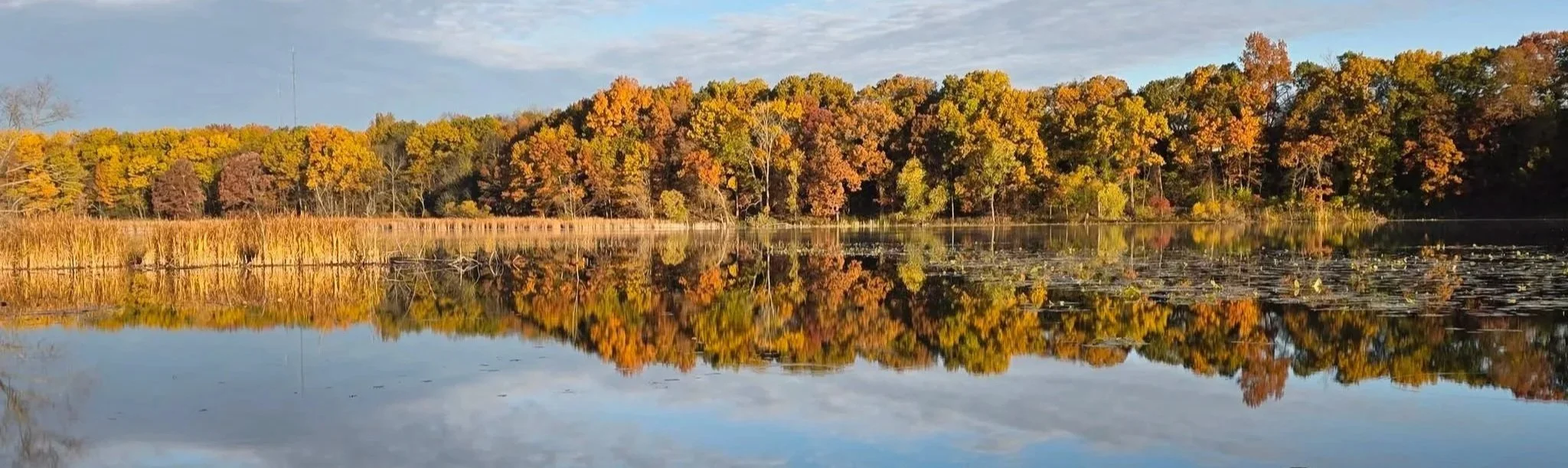
View of lake from Van Deusen cottage
After the Potawatomi were forced from the region, the land that became the preserve was opened to private sale. The land's first recorded owner was a man named Phineas Hunt, who bought it from Michigan's Kalamazoo District Land Office in 1831. The land soon passed to Neil Hindes, whose family farmed it until the Michigan Asylum for the Insane (later called the Kalamazoo State Hospital) purchased it in 1887. The hospital had first tried treating patients through farm work at Brook Farm north of the city, and its success prompted the hospital to expand the idea here, establishing a "Colony Farm" where patients lived in cottages and did therapeutic farm labor. The site, dotted with native oaks, was also known as "Fair Oaks." The lake, earlier known as McMartin Lake (named for the family that owned its northern shore), took the name Asylum Lake from the hospital. On the property, the hospital built patient cottages, a heating plant, and a water tower. By the mid-twentieth century, new psychiatric medications and a broad shift away from large institutions were making self-sufficient hospital farms obsolete, and in 1957 the state ordered its hospital farms closed. Farming ceased at the end of the decade. The cottages housed patients until 1969, and their demolition began in 1971. View historical photographs.
Conservation and Today
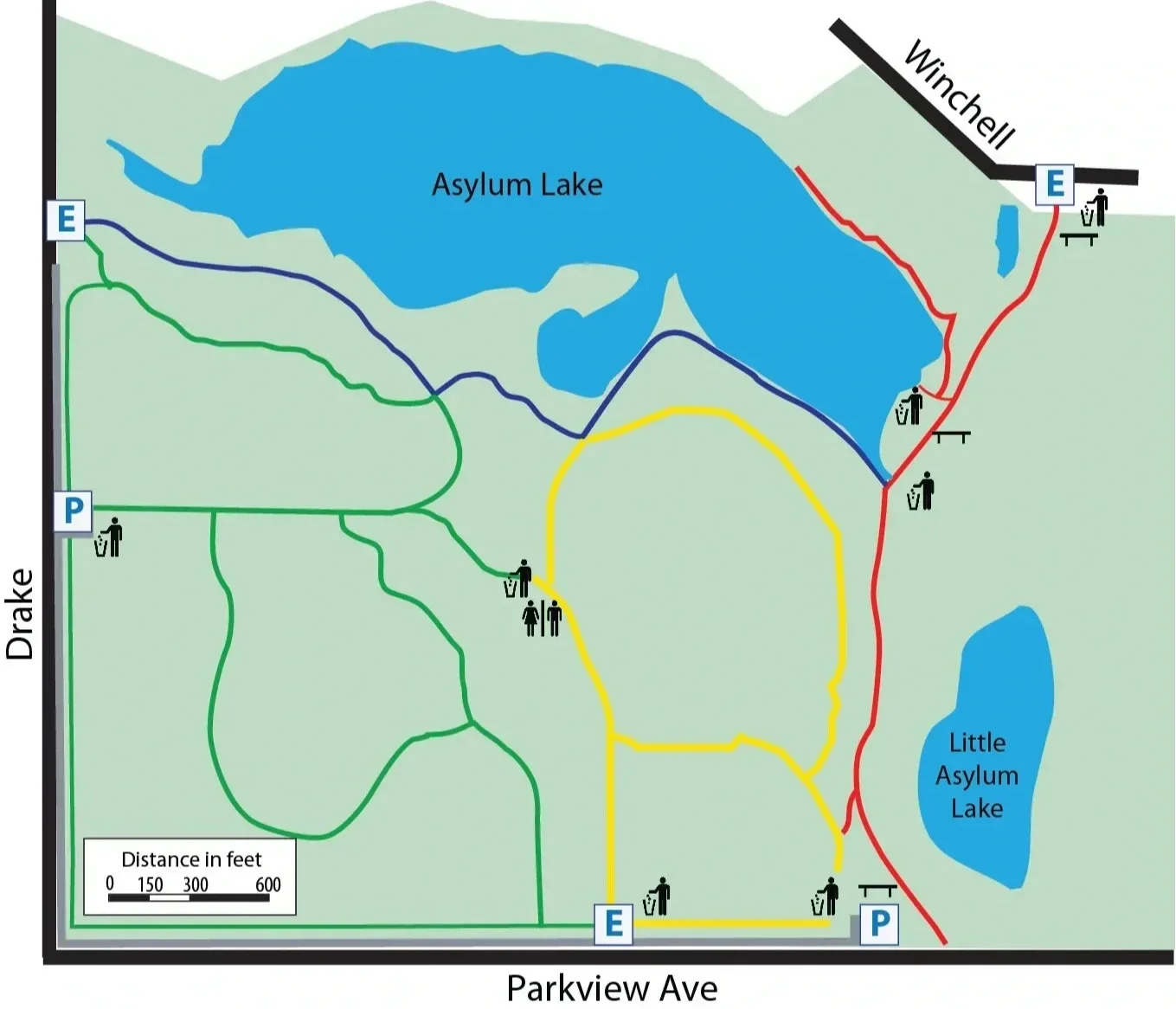
With the hospital complex gone and the property declared surplus, ownership passed to Western Michigan University in 1975 under a state act restricting the land to "public park, recreation or open space purposes." In the following decades, WMU moved to develop much of the surrounding former hospital land, building its research park south of Parkview Avenue and, at one point, proposing to develop the Asylum Lake parcel itself. Many in the community had understood these lands as public open space, and the prospect of losing them galvanized opposition. That effort gave rise to the Asylum Lake Preservation Association in 1990. After a 1998 conservation endowment and years of debate, the WMU Board of Trustees adopted a Declaration of Conservation Restrictions in 2004, protecting the preserve's ecosystem, ensuring passive recreation, and supporting research and education. When the time came to name the preserve, a state representative argued that it should keep the "Asylum" name so that "due consideration be given to the past history of the surrounding area." Today it remains a well-used haven for recreation, learning, and scientific study.